
Repositioning a boutique hotel into a branded luxury asset is one of the most effective value-creation levers in today’s hospitality landscape. Not because the walls change — but because the promise, the perception, and the economics transform.
In a global market where luxury demand continues to outpace supply, repositioning is no longer a cosmetic upgrade. It is a strategic realignment that strengthens identity, elevates guest experience, and unlocks long-term asset value.
1. Why Repositioning Matters Now
Many owners wait too long before making strategic decisions. Performance remains “acceptable”, reviews stay positive, and the urgency to evolve fades. But as industry leaders often remind us: luxury assets don’t fail suddenly — they fade slowly.
Repositioning is the moment where a property interrupts that decline and redefines its trajectory.
Today’s luxury guests and investors expect:
- A clear, differentiated identity
- Experience-led value, not just amenities
- Brand alignment that reassures and elevates
- Operational excellence at international standards
- A narrative worth paying for
A boutique hotel with charm but no structured brand platform is no longer enough. A branded luxury asset with a strong identity, measurable standards, and global visibility is what drives pricing power, RevPAR premiums, and investor appetite.
2. The Strategic Shift: From Boutique Charm to Branded Luxury Power
Repositioning is not about erasing the soul of a property. It is about amplifying it.
Boutique DNA
- Authenticity
- Sense of place
- Human scale
- Emotional connection
Branded Luxury Layer
- International standards
- Distribution power
- Pricing discipline
- Experience architecture
- Asset management rigour
- Global affiliations (Virtuoso, SLH, R&C, etc.)
The winning formula — and the one Gear Up champions — is the hybrid model: Boutique soul × Corporate precision.
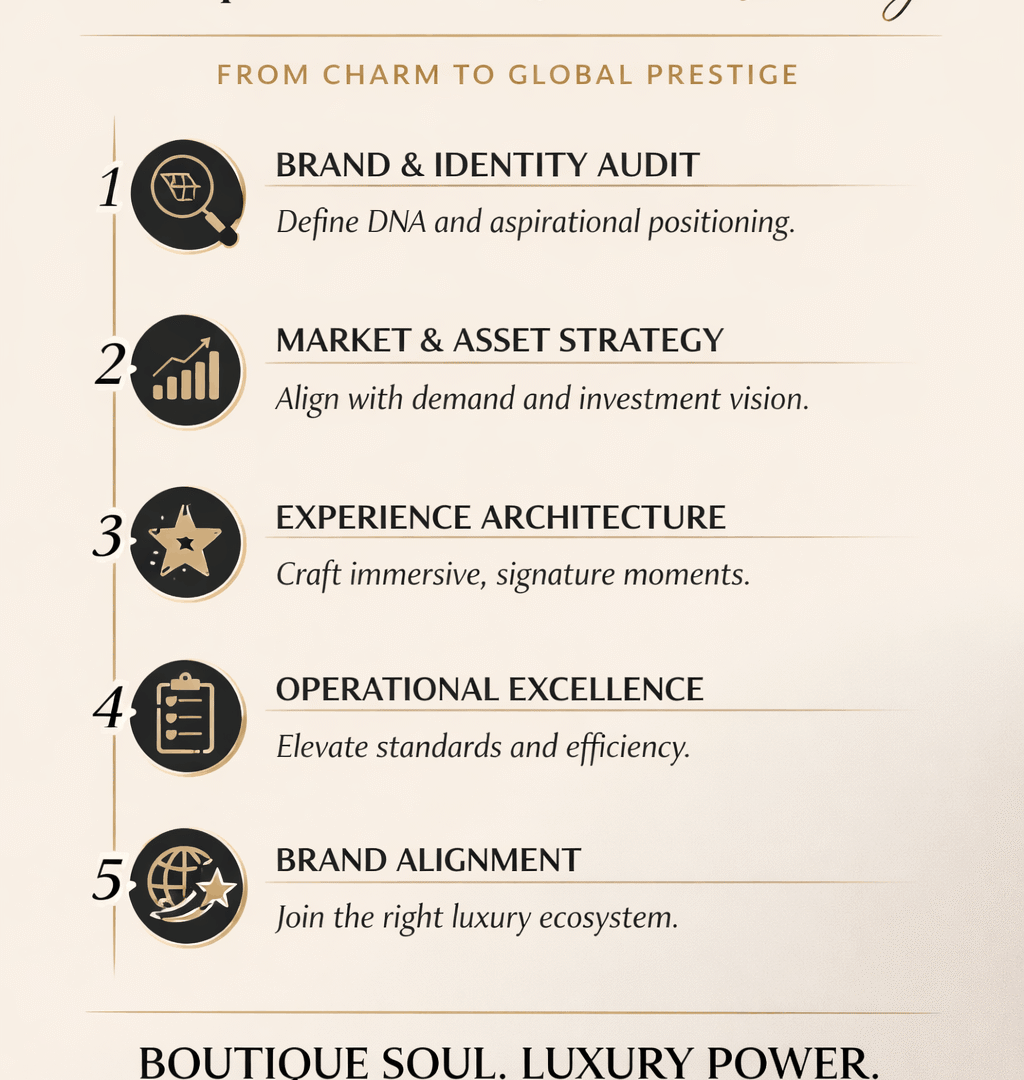
3. The Five Pillars of a Successful Repositioning
1. Brand & Identity Audit
Before changing anything, you must understand everything. The key questions:
- What is the property’s true DNA?
- What emotional territory does it own?
- What is the gap between perception and ambition?
Most repositionings fail because they modernize the product instead of clarifying the identity.
2. Market & Asset Strategy
Repositioning must align with:
- Demand patterns
- Competitive set
- Investor expectations
- Long-term asset vision
Experience-led assets are outperforming the market — and will continue to do so.
3. Experience Architecture
Luxury today is experiential, not decorative. Experience is now a revenue driver, not a “nice to have”. This includes:
- Signature rituals
- Curated moments
- Seasonal programming
- Local immersion
- Emotional storytelling
These elements create differentiation that cannot be copied — they make a hotel a destination in itself.
4. Operational Excellence & Standards
A branded luxury asset requires:
- Service choreography
- SOPs and training
- Guest journey mapping
- Quality control
- Revenue & distribution discipline
This is where boutique hotels often lose value — and where repositioning creates it.
5. Brand Alignment or Affiliation
Not every property needs a global brand. But every property needs a brand strategy. Options include:
- Soft brands
- Luxury collections
- White-label management with strong brand identity
- Full rebranding
The goal is not to “join a brand” — it is to choose the right ecosystem.
4. The ROI of Repositioning
Repositioning is one of the rare strategies that can deliver high impact with controlled CAPEX. Typical outcomes include:
- +15–40% ADR uplift
- +10–25% RevPAR growth
- +20–50% increase in asset valuation
- Stronger seasonality smoothing
- Higher guest retention
- Improved investor appetite
The financial upside is structural, not temporary.
5. Case Study Logic: When Boutique Becomes Iconic
Hotels that succeed in repositioning don’t become “more modern”. They become more intentional. Signs of a successful repositioning:
- Reviews shift from generic to specific
- Pricing becomes proactive, not defensive
- The property becomes a reference point in its market
- Teams understand and embody the vision
- Investors see a clear long-term trajectory
Repositioning is not a facelift — it is a strategic rebirth.
6. The Gear Up Approach
Gear Up operates precisely where value is created: Real Estate × Brand Strategy × Experience Design × Operational Excellence.
Our method:
- Define the identity
- Reposition the experience
- Structure the standards
- Optimise distribution
- Align brand, vision, and operations
- Select the right affiliations
- Measure impact with real KPIs
This is how a boutique hotel becomes a branded luxury asset capable of outperforming its market for the next decade.
Conclusion
Repositioning is not about changing what a hotel is. It is about revealing what it can become.
In a world where luxury demand grows faster than supply, the winners will be the hotels that:
- Know who they are
- Know who they serve
- And express it with clarity and ambition
Boutique gives the soul. Branding gives the power. Repositioning gives the future.